


Testimonials
Gynecology
Cervical Cancer Care in France: The Potential of the COLPOCAMERA

Professor Xavier Carcopino
Colposcopy—an examination in which the cervix is observed under magnification when abnormalities are detected during cervical cancer screening—is considered effective for the early detection of cervical cancer and is attracting attention worldwide. In this interview, we spoke with Professor Xavier Carcopino (hereafter, Professor Carcopino), President of the French Society of Colposcopy and Cervicovaginal Pathology, about the current state of colposcopy in France as well as the usability and handling of the Casio COLPOCAMERA.
Since the 1980s, cervical cancer screening participation in France has remained at around 60%
Professor Carcopino works at Hôpital Nord, Aix-Marseille University in Marseille, a port city with a warm and comfortable climate located on the Mediterranean coast in the south of France. With a population of approximately 860,000, Marseille is the second-largest city in France after Paris. Including the surrounding metropolitan area, more than 1.5 million people live there.
—Could you tell us about your current position and role?
Professor Carcopino: “While working as an obstetrician-gynecologist with a PhD at Hôpital Nord, Aix-Marseille University, I also serve as Head of the Colposcopy Unit at the Faculty of Medicine of Aix-Marseille University. In addition, I am also the President of the French Society of Colposcopy and Cervicovaginal Pathology and the President-elect of the European Federation for Colposcopy and Cervical Cancer Prevention (EFC).”

Hôpital Nord, Aix-Marseille University
—Could you please tell us about the incidence of cervical cancer and the current state of screening and testing in France and across Europe?
Professor Carcopino: “In France, approximately 3,000 women are newly diagnosed with cervical cancer each year, and approximately 1,000 women die from the disease annually. Although France introduced cervical cancer screening in the 1980s, screening rates have remained relatively low, hovering around 60%, and the number of new cases and deaths has not changed significantly since screening began.
In France, women between the ages of 25 and 30 are eligible to undergo a Pap smear every three years. Thereafter, HPV testing is recommended every five years until the age of 65.
Screening uptake varies across European countries. Participation rates in screening programs tend to be relatively high in Western Europe, including France, while lower rates are observed in Eastern Europe, where healthcare conditions are comparatively poorer.
The EFC, to which I belong, places cervical cancer prevention at the heart of its mission and regards colposcopy as playing a vital role in the early detection and prevention of this disease. The EFC is committed to promoting the highest colposcopy standards across Europe and invests heavily in training programs to achieve this. In addition to training activities, the EFC organizes European conferences, and on such occasions, I had the opportunity to attend a presentation by Casio Computer Co., Ltd.”
The diagnostic quality of colposcopy needs to be improved
—Could you please provide information on the daily number of outpatient visits in gynecology and the volume of colposcopy examinations performed?
Professor Carcopino: “Our gynecology department handles approximately 150 outpatient visits per day, of which approximately 10 involve colposcopy.”
—What challenges do you believe colposcopy faces?
Professor Carcopino: “There is a need to improve the quality of colposcopic diagnosis. This requires enhancing the knowledge and technical skills of physicians performing the examinations, as well as providing them with adequate training opportunities.
There is also a need to enhance the quality of the images captured, and I believe that optimizing the entire examination workflow—from image acquisition to the recording of findings—is essential to help reduce the burden on physicians.”
High expectations for an all-in-one colposcopy device
—This time, we asked you to use the Casio COLPOCAMERA. Could you please share your impressions of its use?
Professor Carcopino: “It is compact and ergonomically designed, making it very easy to handle. The built-in battery allows for cable-free operation, and it remains highly maneuverable when used with its dedicated stand. I also found the captured images to be of high quality.
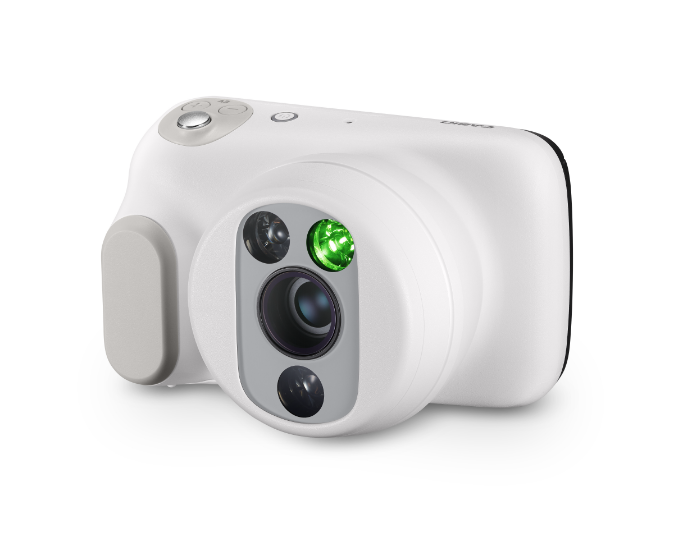
COLPOCAMERA DZ-C100
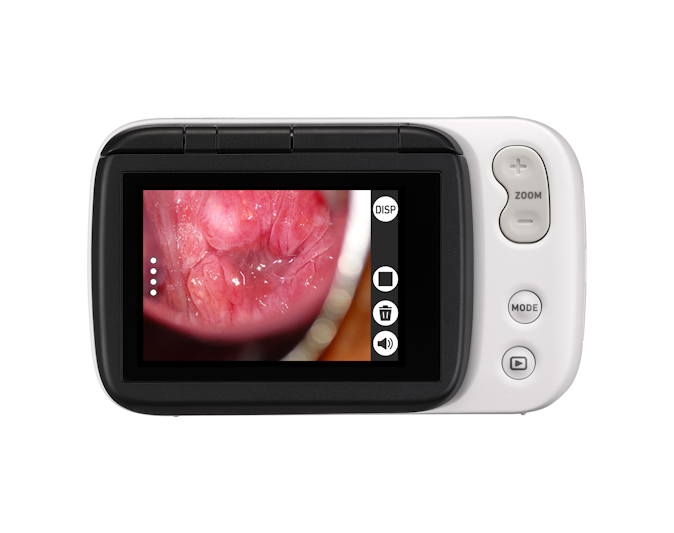
LCD Monitor
This device allows the clinician to maintain a comfortable working distance from the patient, which simplifies camera handling during the colposcopy procedure. It also features an LCD touchscreen interface, like a smartphone, enabling on-screen operation. Switching to the green light mode for enhanced vascular visualization is also straightforward.”
—Are there any areas for improvement or expectations you have regarding the device?
Professor Carcopino: “I believe that a slightly larger LCD monitor on the camera would make it easier to view. In addition, I hope to see the development of an all-in-one colposcopy device that can cover the entire process from image capture to the entry of findings. It would be ideal if this could be achieved while maintaining the device’s compactness and ease of use.
Furthermore, we frequently conduct vulvar imaging (vulvoscopy) at our institution, and devices like Casio’s DZ-D100 Dermatology Camera may also be applicable in such cases.”
—Thank you very much for your time.